
How We Think
Associative Mindworks begins with a simple question: How do thoughts get into our brains?

It’s not magic—it’s biology. Neurons detect patterns in the world around us. These patterns are shaped by our biological needs, expressed as emotion. Through conscious awareness, we translate those emotional patterns into thoughts and decisions.
Other posts explore how the brain’s left and right hemispheres process information differently. Together, they help explain the mental shortcuts and slow deliberations Daniel Kahneman famously called Fast and Slow Thinking.
This post presents a cognitive map—a Table of Contents built from the theory’s consequences. Each section highlights how these concepts influence thought, emotion, and decision-making.
Patterns
To understand how these thinking styles emerge, we start with patterns—the brain’s basic unit of meaning.
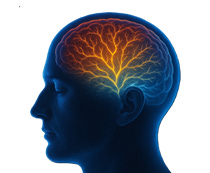
A pattern is a set of features that tend to show up together—something we notice and use long before we learn language. Our brains organize these patterns hierarchically, like nested folders on a computer. The most detailed patterns sit at the edges of this structure, like leaves on a tree.
When we cross an Almost Gate—a mental threshold where detail fades—we shift from specific patterns to more general ones. The brain abstracts. It collapses all the leaves in that branch into a shared, simplified pattern. This is how we generalize, categorize, and make sense of complexity.
The Almost Gate
But not every pattern is treated equally. The brain uses thresholds to decide when to generalize.
When incoming signals exceed that threshold, the neuron fires. And when it fires, it sends the same signal every time: an All-or-None response.
The Almost Gate reminds us that neurons don’t need a perfect match—just a close one. Inputs that are almost alike can still trigger the same signal. But once the signal is sent, the subtle differences between those inputs are lost.
Downstream, the brain treats them the same. This is where abstraction begins: the moment when detail collapses into generalization.
Self-Organized Maps
These thresholds shape how neurons organize themselves—forming maps that reflect experience.
The brain doesn’t come pre-labeled. Genetics wires neurons into receiving layers that extract key features from experience—like the shape of a mother’s face. Similar inputs activate nearby neurons, forming maps that mirror the structure of the world.
These Self-Organizing Maps group related patterns together. They begin in sensory processing and extend into abstract categories—our hopes, dreams, and fears. This mapping lays the foundation for pattern recognition, memory, and meaning.
Patterns and Words
As these maps grow more abstract, they begin to intersect with language.
Humans are lucky. We notice patterns with the right hemisphere and name them with the left.
Before language, infants think in self-referential patterns—emotionally charged and fast. Once we acquired language, we relied on words to tell others what we thought. But the right hemisphere keeps working: it continues to track sequences, consequences, and emotional tone.
Patterns are noticed quickly and interpreted through emotional salience. Similar patterns trigger associations of other patterns we experienced, helping us react and adapt.
Words act as labels for recurring patterns—external (“tree,” “anger”) and internal (“idea,” “hope”). Once named, a pattern becomes easier to recall, compare, and communicate. Language compresses experience, letting abstract patterns travel across time and between minds.
Verbal reasoning is powerful but slow. It often relies on incomplete facts, filled in by belief. Still, naming patterns is what makes complex thought possible—and allows us to hold multiple ideas at once.
Language shapes the left hemisphere orders of magnitude more than the right—naming, sequencing, and narrating what the right first perceives.
Two Thoughts and One Brain
This division—between pattern and language—mirrors the brain’s hemispheric split.
Patterns of emotion and event significance travel up the right hemisphere to the thinking center at the front of the cortex. Meanwhile, words encoding logic and goals enter through the left. This is dual-process thinking: one fast, intuitive, and pattern-driven; the other slow, deliberate, and linguistic.
These modes aren’t in conflict. They work together, searching for the best response to support survival and pursue goals. Since survival is a prerequisite for any goal, emotional signals carry extra weight in the final decision.
Associative Mindworks explores how these two thought modes interact—how they shape perception, memory, and the choices we make.