
The Almost Gate: How Neurons Shape What We Notice
Neural operations lead to Induction, Intuition, and Invention

The intuitive mind is a sacred gift and the rational mind is a faithful servant. We have created a society that honors the servant and has forgotten the gift. Einstein’s statement is dense, with an important insight. What does he mean? That society exalts logic and reason so highly that it overlooks creativity’s role in our brain’s thoughts.
Many thinkers have identified associations as tied to inventive thought, although they haven’t explained how the associations arise. The Almost Gate fills that gap by using neural properties to progress from inputs to similarities to associations.
The greatest physicist of the 20th century had a worthy predecessor in ancient Greece who emphasized the role of similarities. Aristotle in De Poetica wrote, The greatest thing by far is to be a master of metaphor. It is the one thing that cannot be learned from others; and it is also a sign of genius, since a good metaphor implies an intuitive perception of the similarity in dissimilars. Aristotle’s conclusion seems nearly self-contradictory, but literally captures the action of the Almost Gate which treats two objects that have differences, but have enough similar features that substituting one for the other can often be profitably done. That’s association in a nutshell.
Associative Thinking Differs from Logic
How can we think sensibly if we’re not using logic? The trick is the neural threshold and its all-or-none principle play an important role in how we come to understand things about which we only have limited information. They create the Almost Gate, permitting us to go beyond pure logic. This isn’t illogical thinking, but associative thinking, creative thinking like Einstein and Aristotle identified in their pithy quotes.
The Almost Gate treats data that are slightly different as identical. Although this violates logical reasoning, it opens up the possibility of seeing associations between non-identical data, opening the path to unexpected relationships.
The effects of the neural Almost Gate begin with sensory input. Sensory input is keyhole information. We only know the slice we experience and that sensory slice may include part of a table obscured by a person in a chair, nonetheless, we are sure the entire table is there. After the visual centers add contours, colors, distance, and the like to our observed keyhole, that information flows through the brain’s neural pathways and ultimately arrive in the prefrontal executive areas. Before reaching that pinnacle of conscious thought, there are crucial processes in which neural Almost Gates abstract essential details and shuttle the concepts that share similarities to the same lanes in the neural pathways.
If this introductory newsletter piques your interest, there’s much to look forward to. I welcome your thoughts—whether to clarify points or to explore aspects that need deeper discussion.
Understanding the Almost Gate
The Almost Gate Substack is clustered into four aspects:
Neuroscience: How does the neural structure of the brain affect thought? Beyond words and logic, a fundamental thought mode—association—arises from neural properties, resulting in the Almost Gate. An important consideration is the neural threshold is a genetic feature that varies among the population. Some people have a high threshold resulting in recognition of similarities when a high percentage of features match. Other people have low neural threshold which results in them claiming similarities between objects, concepts, or situations that high threshold people don’t recognize. (Tag: Neuroscience)
Thinking Modes: Associations, not just logic, power our thinking. We experience only part of reality. How does our brain abstract it into an internal reality upon which we base decisions? (Tag: Thinking Modes)
Learning: What’s the difference between genetic imperatives and learned knowledge? The evolution of our brains reveals genes pass onto us certain base-level behaviors. (Tag: Learning)
Creativity: The Almost Gate lies underneath induction, intuition, and creative thoughts. As concepts travel neural pathways, abstract details connect seemingly unrelated ideas. (Tag: Creativity)
My Perspective
I’ve spent over five decades in Mensa, which means I’ve had plenty of time to ponder the quirks of human thought—over chess games, deep debates, and, yes, the occasional overcomplicated argument about the best way to brew coffee.
What I’ve found is that intelligence isn’t just logic. Intelligence is also powered by intuition, associations (pattern recognition), and other subtle ways our neural architecture shapes thought.
Layers of Thought
The Pyramid of Cognition (below) encapsulates key relationships between genetic demands, emotional responses, and conscious considerations.
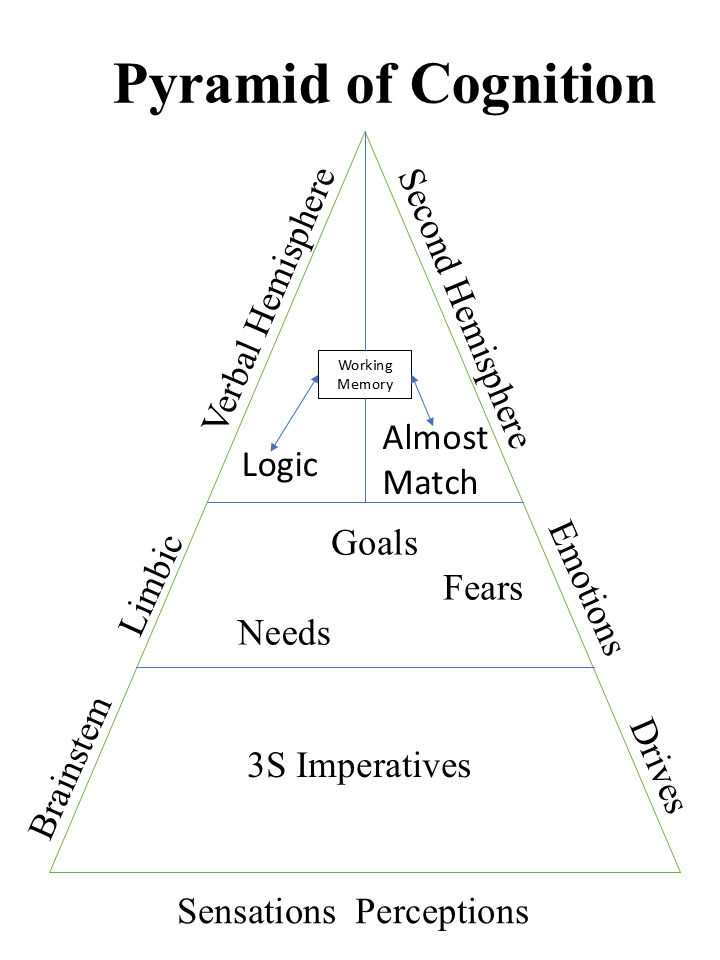
Brainstem (530 MYA): Handles life-supporting processes like homeostasis, hunger, and sexual drive. The Almost Gate operates in the brainstem which has a flattened neural structure but is frozen in genetic code. Different experiences do not result in a learning a new way for the brainstem to react to the world.
Limbic System (150 MYA): Adds emotional responses and associative thinking. Limbic structures like the hippocampus, amygdala, and cingulate cortex have a four-level neural structure with Almost Gates that are trained by repeated experiences, typically starting when a person is two to three years old. Emotions are formed, by early experiences, behaviors, and consequences of trying to satisfy our needs and goals while squelching our fears. Rarely can all three be satisfied simultaneously.
Neocortex & Prefrontal Lobe: Integrates cause-and-effect reasoning, memory, and decision-making. Generally, there are six layers in the cortical structure: from sensory lobes to association areas to executive areas in the prefrontal lobe and back to the motor area; however, the neural pathways often transmit discrete output signals from multiple brain sites to neural Almost Gates, which lead to similar signals, travelling the same lane. That is, the similar signals become associated by their lanes in the neural pathway.
Consider taking a moment to sketch or outline your personal Cognitive Pyramid. Which layers of thought—basic imperatives, emotional drives, or higher-order thought—do you think are most influential in your decision-making?
If you feel like sharing, drop a quick outline or a few words describing each layer in the comments. I’d love to see how you visualize your own cognitive pyramid, and I’m sure other readers would find it fascinating too.
Don’t miss future posts, which will develop these points further. We'll explore:
The symbiotic relationship between the thought modes of logic and associations.
How the Almost Gate shapes decisions
The next post will explain how neural properties give rise to the Almost Gate, revealing their role in shaping associative thought.