
What Powers Creativity? A Hidden Mechanism Called Associative Substitution
Exploring how the brain swaps ideas to spark insight—beneath awareness and beyond intention.

In deductive logic, conclusions drawn from premises are limited to the information contained within its premises. It can prove, refine, and test—but only within the boundaries of what it’s given. Creativity, by contrast, dares to leap outside the premises. It introduces what the system doesn’t contain, what isn’t yet modeled, and what resists compression.
Do you remember learning to read? Perhaps your mother read aloud a story while holding a book, you turn the page when she stopped, or perhaps it was Sunday morning cartoons. She pointed to squiggles that looked like Snoopy’s friend's footprints and moved her finger as she read.
With time and repeated experience, you come to recognize some squiggles as letters. You didn’t learn to read all at once. First, the squiggles on the comic pages appeared to be motions. They hinted at something. Then, one day, they weren’t squiggles anymore. They were letters with sounds. Then names. Then actions. Meaning wasn’t delivered—it accumulated, patterned, and bloomed.
You didn’t just learn words—You learned how patterns become language.
What Is Creativity?
Creativity emerges not from certainty, but from similarity. “Almost matches” lead to creative interpretations by activating associations—not just randomly, but within layered hierarchies of features, patterns, and categories. Meaning arises not from perfect identity, but from near-enough alignment. This substitution isn’t arbitrary—it’s associative, evocative, and generative.
This is the essence of the Almost Gate: when a close-enough fit in the feature-pattern-category hierarchy triggers new insights. The Neural Threshold post provides a neuron level explanation of the Almost Gate.
Induction, Intuition, Insight: Creativity’s Preludes
Induction builds patterns from fragments. Insight unifies them with a sudden structural fit. Intuition, meanwhile, doesn’t construct—it navigates. It leaps across pattern spaces, guided by fluency in prior associations, not conscious reasoning. It feels like knowing without knowing why.
Where induction is bottom up, and insight is a snap-top fit, intuition is a lateral glide. It doesn’t create the leap; it senses where one might be.
These aren’t lesser notes in creativity’s score; they’re its recurring motifs—subtle, often subconscious, and essential to the orchestration.
Neural Layers That Learn
In the Learning post, Wilder Penfield’s observation that repeated experiences shape that certain neural layers in the brain map to our bodies. These self-organizing maps don’t calculate by creative insights—they stumble upon order by grouping features (shape, rhythm, emotional valence, category) that frequently co-occur. They form topographies of meaning through exposure, not design.
Let’s look at a simplified neural simulation:
The system receives 5×7 pixel inputs (e.g., the letter E).
A 10×10 output layer learns to respond through repeated exposure.
Synapses adjust until the same input (like E) consistently activates the same neuron.


The leftmost image above shows that an E maps to the winning neuron in the second row and second column.
The middle image shows a slightly malformed E. With altered features, still triggers the same neuron. Close enough—an Almost Match. Despite the feature difference, the network generalizes. It “accepts” almost matches, signaling that resonance, not exactitude, governs recognition.
The image on the right shows A, B, and Z to indicate all letters were inputted. Each letter finds a neuron “home,” distributed across the output field. Patterns emerge from statistical closeness, not rule-based alignment.
Analogical Reasoning: Bridging Systems
Analogical reasoning maps shared structures across domains. It builds bridges of similarity that let new truths walk across.
One classic case: Dmitri Mendeleev and the Periodic Table. In 1871, Mendeleev arranged the ~60 known elements by atomic mass and chemical properties. Seeing repeating patterns, he predicted the existence of undiscovered elements to fill the table’s gaps. He even suggested corrections to the recorded weights of known elements—based solely on analogical fit.
Scientists discovered gallium and germanium years later—exactly where he predicted, with the properties he forecast. Analogy paved the way for bold, creative reasoning.
Rules and structure still govern analogy. Analogy bridges systems.
Associative Substitution: Making Meaning Move
Associative substitution bends categories. It lets us trade the generic for the particular—and sometimes, solve the unsolvable.
Imagine you’re struggling to explain how a new tech platform functions. The generic category—tool—is too bland to help. But then you might substitute a particular member of that category—Swiss Army knife. Suddenly, its distinctive features—multifunctionality, adaptability—let you reframe the problem. The metaphor may land or fall flat, but either way, it surfaces attributes germane to the original dilemma.
Each category has members with features shared among all members and with distinctive features unique to each member.
Repeated Almost Gate operations result in layered categories, often in hierarchies. When reasoning stalls, we call on specific members of a category. Sometimes their distinctive traits offer a novel solution.
The substitution may land or miss. But either way, it reveals distinctive features that the generic pattern or category had smoothed over. That reflection can open an alternative path.
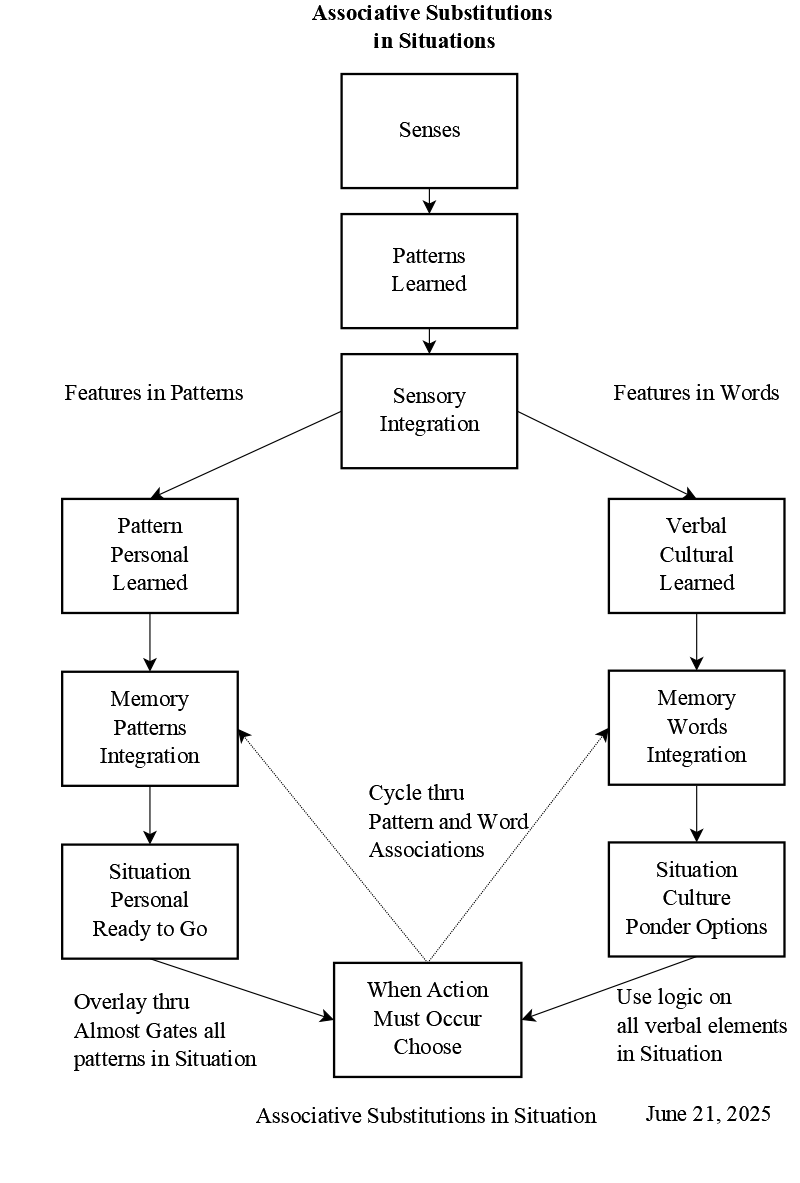
The Associative Substitution in Situations diagram above organizes important information. Situation in this context implies the entire set of current sensory inputs along with the memories, knowledge, and emotional values that the sensory data flow through on their way to the executive areas of the prefrontal lobes for conscious consideration.
Category Structure
The patterns we develop begin with sense data. After the sensory data has somewhat coalesced, it separates into two streams. The patterns column represents information that is stored in distinct experience sets, while the words column represents data that is stored in culturally defined terms.
The minimally processed sensory information travels neural pathways through memory (heightening detail contrasts), knowledge (linking disparate pieces), and emotion values (assigning personal importance).
Creative Substitution Mechanism
Arriving in the executive areas, the pattern handling and the word handling differ.
The pattern thought stream always have a behavioral response ready to the input as it understands the world. It may have an inappropriate response, but it will always have a response ready.
All the patterns that comprise the situation are overlaid summation passing through or stopped by an Almost Gate.
The verbal thought stream always strives for a better response, to the input as it understands the world. It cannot always find a response, much less a better response, when it is lacking information.
We use all descriptions of the situation as premises in the logical argument to generate a satisfactory conclusion.
Until we decide to act, patterns and words exchange their best information through working memory. Each can try the other’s information to see if it generates a response more productive to the person’s needs and desires while lessening fears.
This is an iterative process until external reality or your own body demands a response.
The pattern overlay procedure can use specific patterns which may have extra distinctive features which can exceed the neural threshold of the Almost Gate. When this happens, in working storage, the verbal-logical thought stream may pick up the substitution and find a better logical conclusion based on it.
Evaluating Outcomes
The executive area weighs interim responses. They either pass or not an Almost Gate, which corresponds to the desired result.
However, it is not always necessary to respond to the outside world. That’s a prime achievement of society. The need to eat, to have sex, and to avoid danger does not consume all of our attention all the time as they did in days long ago.
Some people wait for the perfect response. Others, after awhile, tire of the mental effort and take the ready response from the pattern thought stream.
If the fit holds—we call it creativity. If not—we discard it, but still learn from the misfit. We refine understanding by seeing which features proved relevant—and which didn’t—to resolving the issue at hand.
Core Takeaway
Almost Matches generate creativity. The Almost Gate is the mechanism by which categories yield new alternatives—not by identity, but by resemblance. It lifts hidden features into reasoning when the generic fails.
As considered earlier, we might say creativity is a tool, but that’s a vague category. A better category would be a Swiss Army knife. Why? With creativity, we gain multiple tools—induction, intuition, insight, analogical reasoning, and associative substitution.
Darwin saw variation where others saw order.
Kepler saw ellipses where Brahe insisted on circles.
The leap wasn’t in the data—but in a new fit.
Your Turn
Creativity can help you adjust to life’s changes.
In a world where so many inherited truths are eroding, we don’t just need new answers—we need new ways of looking at reality.
To navigate a world that no longer follows inherited rules, we need a faculty that extends beyond deduction’s cautious precision.